
Moor Amps Angel 6 Mk II Power Amplifier
Moor Amps’ flagship stereo power amplifier pairs a low-feedback circuit with a 550,000 µF three-island power supply. It delivers 150 W per channel into 8 ohms, holds steady into 2-ohm loads and has the current reserves to drive genuinely difficult speakers.
Made to order in 1-2 weeks. Delivery & returns
£12,800.00
including delivery and VAT
Have a question? Call us on 0161 399 0993 or contact us. We also offer part exchange and price matching.
About the Moor Amps Angel 6 Mk II
Low feedback, high current
The Angel 6 Mk II is the flagship stereo power amplifier in the Moor Amps range. It’s rated at 150 W per channel into 8 ohms and 300 W into 4 ohms, and its output stage will deliver 580 W into 2 ohms on dynamic peaks.
The headline numbers matter less than how they’re achieved. Rather than relying on large amounts of negative feedback to correct a less linear circuit, Moor Amps designs the circuit to be linear in the first place and uses only a small amount of feedback. Distortion still measures below 0.01% THD and IMD into a typical loudspeaker load.
That linearity is backed by serious current reserves. Overload protection doesn’t step in until ±29 A, so low-impedance and power-hungry speakers can be driven hard without the amplifier running short of headroom. Large floorstanding speakers and awkward loads that need current, not just voltage, are where the Angel 6 Mk II earns its place.
A supply rebuilt around 550,000 µF
The Mk II changes are concentrated in the power supply. Total capacitance has gone from 200,000 µF in the original Angel 6 to 550,000 µF, spread across Moor Amps’ three-island supply – an arrangement that uses three times as many capacitors as a conventional amplifier supply.
Moor Amps applies its low-feedback approach to the regulators as well, so the amplifier modules draw on clean, high-current DC rails. The impedance of the supply feeding each module has also been reduced. Keeping supply and amplifier in one chassis, with shorter and re-routed tracks, stops that low impedance being lost in the wiring between them.
The aim is a supply that holds steady when the music asks for sudden bursts of current. Moor Amps reports the biggest gains as a wider, deeper soundstage, more natural dynamics on piano and percussion, and bass lines with more texture and drive.
Slimmer, still heavily damped
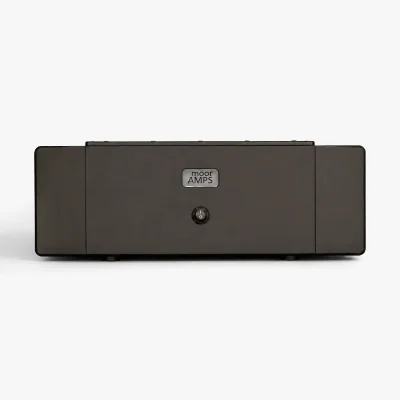
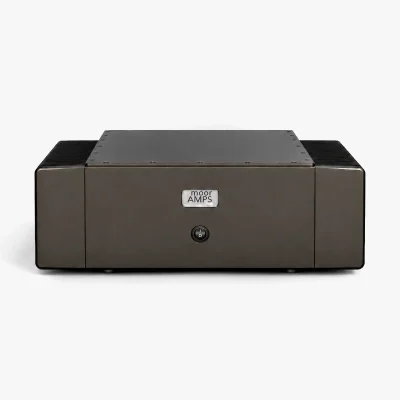
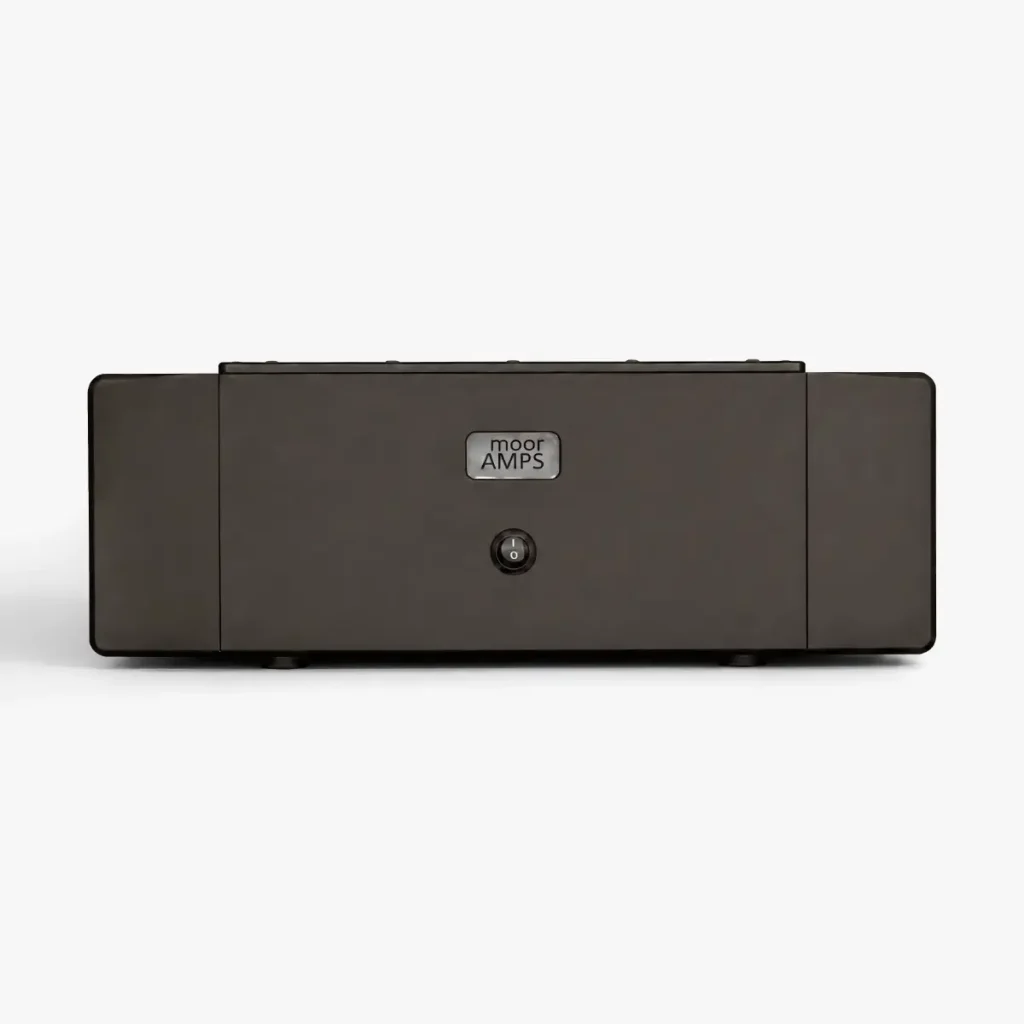
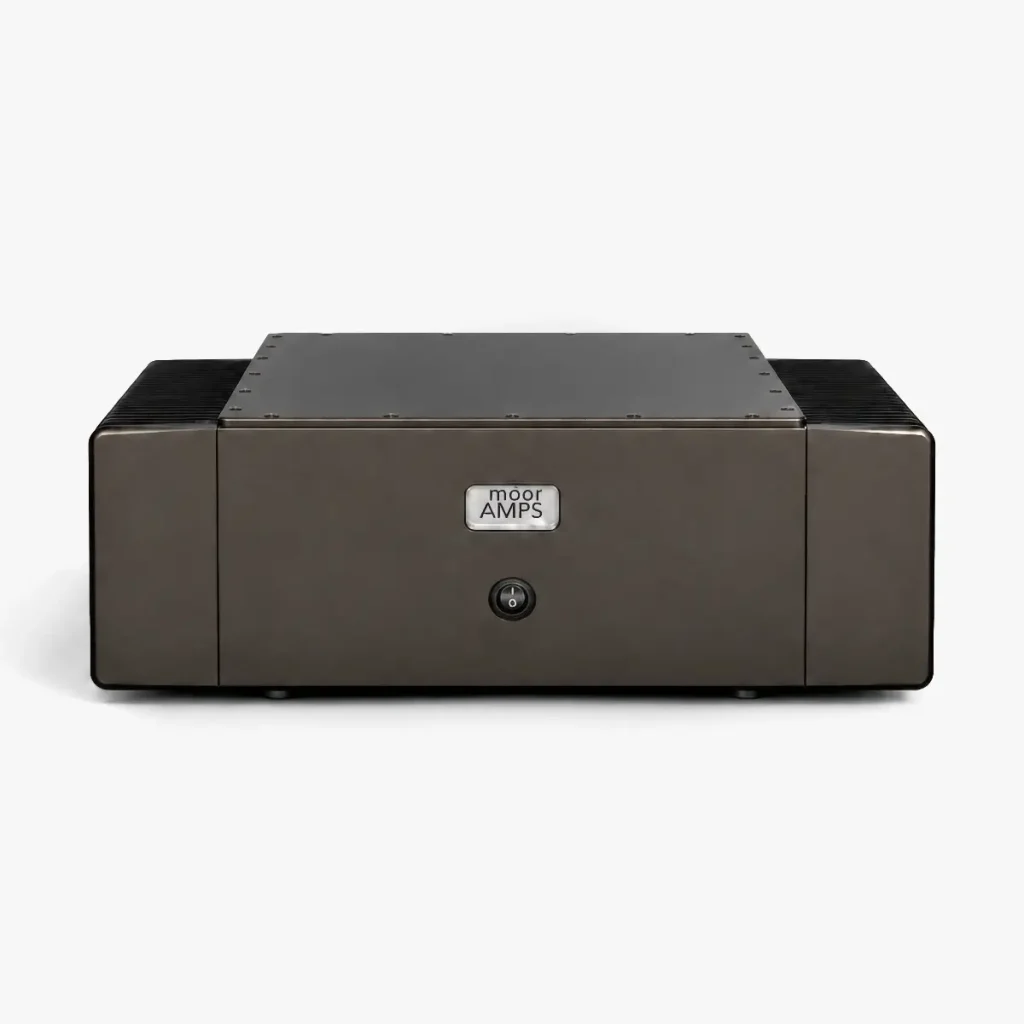
The Mk II casework is considerably slimmer than the original Angel 6, at 171 mm tall, which makes it far easier to accommodate in a standard hi-fi rack. It still weighs 30 kg. The machined panels are deliberately made in different thicknesses so that they damp one another, keeping vibration away from the circuit boards.
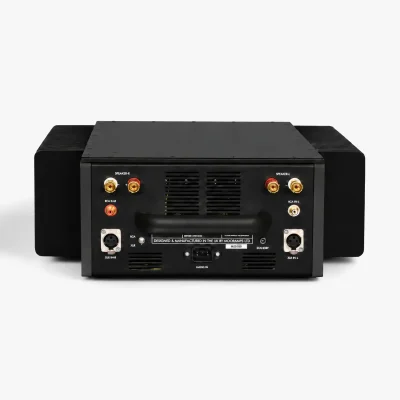
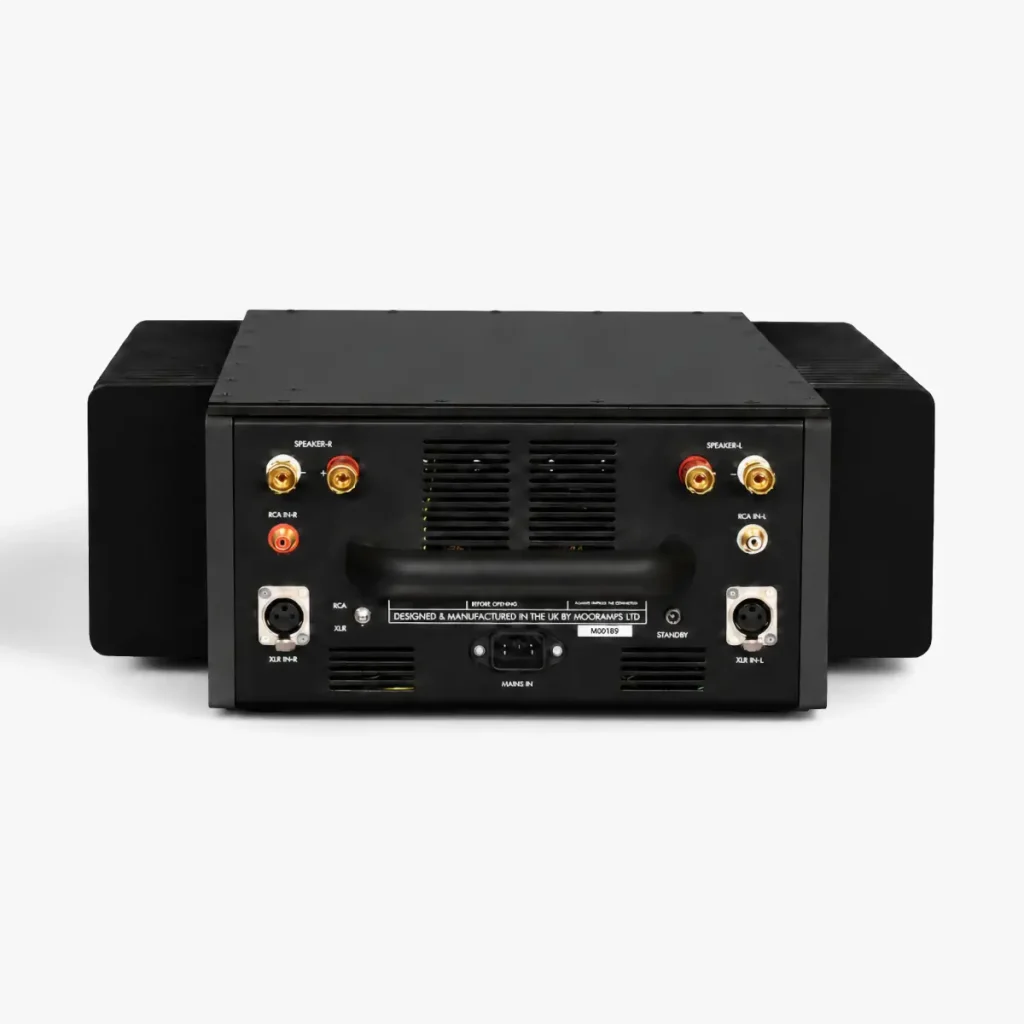
Inputs are provided on both balanced XLR and single-ended RCA, each needing 1 V for full output. Speakers connect via WBT Classic terminals that take bare wire, spades or 4 mm plugs.
Partnering and upgrading
The Angel 6 Mk II is designed to partner the Angel Pre preamplifier, whose standby trigger outputs bring the power amplifier in and out of standby with it. For a digital front end, the Mana DAC completes the system.
If you already own an original Angel 6, Moor Amps can bring it up to full Mk II specification through a return-to-factory upgrade. Contact us for details.
Features
Power & amplification
150 W per channel into 8 ohms
300 W into 4 ohms, with 580 W available on dynamic peaks into 2 ohms.
Stable into 2-ohm loads
Rated for a 2-ohm minimum, with 4–16 ohm nominal speakers as its normal territory.
Low-feedback design
Linear by design rather than corrected by heavy feedback – THD and IMD below 0.01%.
Overload protection at ±29 A
Only intervenes at very high current, alongside over- and under-temperature cut-outs.
Power supply
550,000 µF of capacitance
Up from 200,000 µF in the original Angel-6 – almost three times the reserve.
Three-island power supply
Three times the capacitor count of a conventional amplifier supply.
Low-feedback regulation
The same circuit philosophy applied to the DC rails that feed the amplifier modules.
Single-chassis layout
Short, re-routed supply tracks keep impedance low between the capacitors and the output stage.
Connectivity & build
Balanced XLR and RCA inputs
1 V for full output on both; 3 kΩ input impedance on XLR, 15 kΩ on RCA.
WBT Classic speaker terminals
Accept bare wire, spade connectors or 4 mm plugs.
Slimmer machined casework
171 mm tall, with panels of differing thickness that damp each other.
230 V or 115 V versions
230 V 50 Hz as standard, with a 115 V 60 Hz version available.
Specifications
| Brand | Moor Amps |
|---|---|
| Analogue Inputs | 1 x balanced XLR, 1 x unbalanced RCA |
| Input Sensitivity | 1 V RMS (full output) |
| Input Impedance | 3 kΩ (XLR), 15 kΩ (RCA) |
| Power Output | 2 x 150 W (8 Ω), 2 x 300 W (4 Ω) |
| Dynamic Power | 580 W (2 Ω) |
| Minimum Load | 2 Ω |
| Speaker Impedance | 4 Ω – 16 Ω nominal |
| Speaker Terminals | WBT Classic (bare wire, spade or 4 mm plug) |
| Frequency Response | 5 Hz – 50 kHz ±1 dB |
| Distortion | <0.01% THD (typical speaker load) |
| Intermodulation | <0.01% (typical speaker load) |
| Protection | ±29 A short-circuit/overload, +55 °C over-temperature, +5 °C under-temperature |
| Mains Supply | 230 V AC 50 Hz (115 V AC 60 Hz optional) |
| Power Consumption | 1300 VA max, 80 VA idle, <0.5 W standby |
| Dimensions (W x D x H) | 460 mm x 480 mm x 171 mm |
| Weight | 30 kg |